
Balance helps us stay upright against gravity and steady in a very complex world. Our amazing ability to balance is something we take for granted until something in this finely tuned system goes wrong.
We use three main systems for our balance:
1. Proprioception (sensors in our muscles and joints that tell us where our body parts are in space)
2. Vestibular system (our primary balance organ in our inner ear)
3. Vision (helps us keep our gaze on a point and helps us orientate us in our environment)
Information from these three systems is brought together and processed by our brain very quickly (mainly in an area called the Cerebellum) and then the appropriate reaction is sent to our muscles to keep us upright.
This happens very quickly and this information is constantly being updated. Its so incredibly fast that we don't even realise it is happening!
When things go wrong with one of these systems the other systems have to work harder. If you stand in a challenging position, on one leg for example, and you close your eyes (take away your vision) it is harder to balance. As a result, your muscles in your feet and and around your ankles work harder to help you balance and you will need to concentrate harder on sensing where upright is.
If you can’t feel one or both of your feet very well due to numbness or pins and needles, then your proprioception is decreased and other parts of your body have to compensate more.
The good news is that this balance system is one of the most adaptable systems in our body. If we practice balancing it will improve. The trick is to pitch it at the right level for you and to practice often. Ask one of Bespokes Physiotherapist's if this is an are you would like to explore and improve. Make it part of your day. Make it playful and fun. Mix it up and vary it.
As we like to say, get some balance play in your day!
Here are some ideas:
1. Stand with one foot in front of the other while brushing your teeth (or on one leg if this is where you are up to). You have the sink and the other hand for safety if required.
2. Every time you walk down a particular section of corridor in your house (or at work) do it a different way. You could try walking on your heels, the next time on your toes, or walk the ‘tight rope’, walk sideways, walk backwards (if safe to do so). Safety first!
3. Try to get a little bit of spring in your day. When was the last time you skipped? When was the last time you jumped or hopped? There are easier variations of these you can ask your physiotherapist about.
4. Throw a ball up and down while standing in a position that challenges you. Try following the ball with your eyes.
5. Try balancing on a wobbly surface (Balance Foam is great) while watching the first 5-10 minutes of a Television show. If standing is too difficult sit on a wobbly surface instead (ball or balance foam or balance disc).
6. Balance whilst waiting for someone, a tram, a train, the microwave timer, the photocopier etc…
7. If you have a standing desk at work check/read your emails standing on some balance foam or a balance disc (transportable, light, good cushioning).
8. Dancing is amazing for your balance. Put on a song and dance like no one is watching. Or join a dance class. You would be surprised what is out there. Dance for Parkinson’s Disease or Tap dancing for bone density are just two examples.
In the pictures below are some examples (thanks to my parents both 74 years old). Two different people, two different balance tasks pitched to their level.


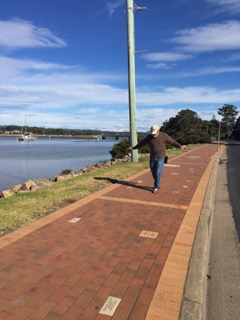
My Dad is recovering from a stroke. Every time he walks along a particular section of path made of bricks tries to walk along a single line of bricks. He overbalances and steps off the bricks to the side occasionally, which is a great stepping balance reaction. He keeps trying, he is improving!
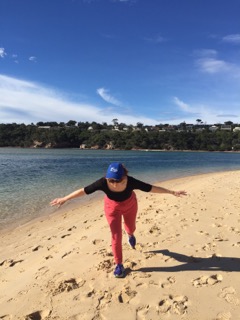


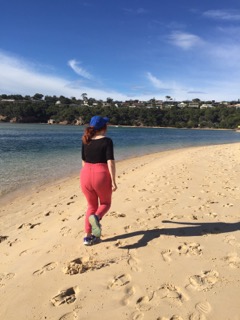
My Mum walks along the beach and for short 10 metre sections she tries skipping. She finds it difficult on the uneven ground but it's fun and the more she practices the better she gets! Mum also goes to tap dancing lessons for her bone density and balance once a week.
Have you ever watched a child play? They never just walk from A to B. They step over the lines, walk along a curb, jump only in the dark grey squares of a tiling pattern, they walk along a line of bricks, or a wall. They do not even think of practicing their balance, it is just fun.
So..... never act your age, find some balance play in your day!
WE'D LOVE TO HEAR WHAT SORT OF BALANCE PLAY YOU'RE INCORPORATING INTO YOUR DAY!
